
Rate cuts are unlikely to be aggressive, in our view.

If this turns into reality, India's gross domestic product (GDP) growth will be the lowest since 2012-13, which could severely hit job creation and income growth in the near term.

IMF attributes the slower growth rate to supply-side bottlenecks.

Rajan said the process of dialogue with the government did not reach a stage where he could have agreed to stay on

What stood out in his 15-year journey as a member of the political executive at the Centre was his glowing record as India's most successful and effective finance minister. Both as prime minister and finance minister, he understood the importance of gradualism, except when the economy or the polity was in a crisis.

Rajan had overturned the majority opinion of the members and chose to hold the rates at the last monetary policy review in October.

The bigger worry is that its effects could linger well into the next financial year.
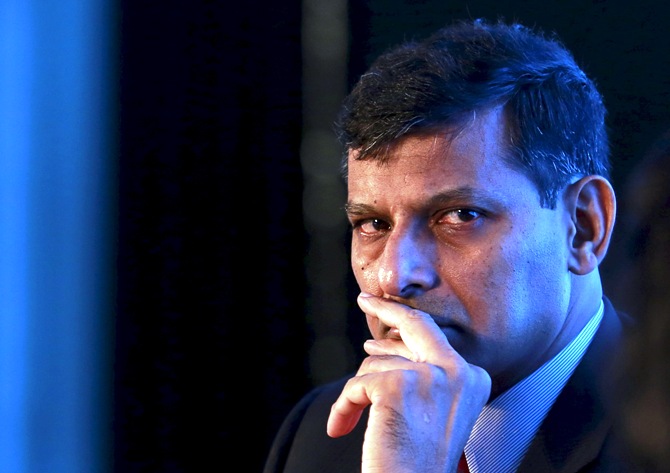
We need a change in mindset, says the RBI Governor.

India's services sector activity moderated further in January as new business rose at a noticeably slower rate amid the escalation of the pandemic, reintroduction of restrictions and inflationary pressures, a monthly survey said on Thursday. The seasonally adjusted India Services Business Activity Index fell to 51.5 in January, down from 55.5 in December, pointing to the slowest rate of expansion in the current six-month sequence of growth. For the sixth straight month, the services sector witnessed an expansion in output.

Analysts are divided on their retail price inflation forecast, with some saying the first quarter numbers will overshoot the RBI target by as much as 60 bps while others are softer in their estimate. Consumer price inflation retreated from its 15-month peak of 7.4 per cent in July to 6.8 per cent in August, much lower than the market expectations, despite vegetable prices remaining elevated at 26.1 per cent. Food inflation eased to 9.9 per cent from 11.5 per cent, led by some cooling of inflation in vegetables, cereals, pulses and milk.

'Rate cut should reiterate RBI's commitment in providing confidence to consumers and small business.'

Finance minister Arun Jaitley has delivered a Arun Jaitley delivered a bold, far sighted budget

The RBI may grant licences for setting up small finance and payment banks by April 2015.

A 13-member group, headed by RBI Executive Director R Gandhi, has made various recommendations on G-Sec market, retail participation and interest rate derivatives market.

The broad market depicted strength. 1,525 shares rose and 1,131 shares fell. A total of 156 shares remained unchanged

Rajan's exit will neither affect the RBI's de facto independence nor its working.

With inflation remaining at elevated levels, central banks around the world, including the Reserve Bank of India (RBI), will kill excess demand in economy over the next six to eight months, sources in the know said. They also indicated that there could be a rate hike in June, when the inflation forecast for the current financial year would be raised. The RBI, the sources said, might announce more steps such as raising the limit on held-to-maturity (HTM) bonds to support government borrowings but might not come out with any further quantitative easing GSAP (Government Securities Acquisition Programme) measures.
A staunch defender of demonetisation, it would be interesting to see how he handles the government's increasing demand for more cash from the RBI, and letting some weak banks get out of prompt corrective action.
Lower inflation, FCNR(B) outflows likely to influence central bank decision

The year 2014-15 could well go as one of long-pending financial sector reforms, expected to have a lasting impact.
'For the RBI, for a central bank, reputational risk is the worst risk.' 'Credibility is the worst risk,'

The RBI governor-designate may be economical with spoken words, but is known for his sharp and critical writings

Costlier vegetables and eggs pushed up retail inflation to a nearly six-and-a-half year high of 7.61 per cent in October, keeping it significantly above the comfort zone of the Reserve Bank.

High rates of such schemes deter banks from dropping borrowing rates - and thus lending rates
.jpg)
Industry's demand for a reduction in the repo rate, currently 8 per cent, has gained momentum after wholesale and retail inflation eased in February.

The use of RBI capital to strengthen public sector banks will have many positive implications for the economy -- and a few manageable downsides, points out R Jagannathan.

Costlier vegetables slowly pushed retail inflation, which had remained well within the Reserve Bank's comfortable level of 4 per cent during most part of 2019, peaked to more than three-year high of 5.54 per cent in November.
The downward surprise in Q2 stemmed from a stronger-than-anticipated drag from gross fixed capital formation and marginal weakness in private final consumption expenditure. In Q3, projection errors emanated mainly from a steep unanticipated contraction in gross fixed capital formation, which was the deepest in the new series of GDP.

'The no-rate cut policy and preference to wait for the Budget and clarity on the fiscal front demonstrate RBI Governor Shaktikanta Das is maturing in his new role,' notes Tamal Bandyopadhyay.

Rising crude oil prices, traction in China equities and inflation concerns back home are casting a shadow on the Indian equity markets in the short term, believe analysts at Jefferies. They said this could see the markets remaining range-bound in the near term before the next leg up.

Large urban co-operative banks may come to be solely under the provisions of the Banking Regulation Act, even as the smaller among them are to remain within the exclusive fold of the Registrar of Co-operative Societies. The upcoming changes will bring the curtains down on the vexed issue of dual control of UCBs, which has been in vogue for 54 years. The new framework will affect 1,551 UCBs in the country, which had a total business of Rs 7.36 trillion.

The principal challenge for Rajan's successor is to work with the Bank Board Bureau and the finance ministry to complete these processes of banking reform.

The finance ministry has received about 100 applications for the post, which have been sent to the high-level panel that will select a suitable candidate for the post, sources said.

Duvvuri Subbarao recounts how his tensions with P Chidambaram and Pranab Mukherjee, then finance ministers, over monetary policy spilled over into other issues in the central bank in this excerpt from Who Moved My Interest Rate?, his memoir of his term as Reserve Bank of India governor.
North Block and Mint Road seem likely to now stick to the earlier convention of the RBI governor coming to Delhi and being the only MPC member meeting the finance minister and senior bureaucrats on pre-policy meetings

Central bank moves to infuse liquidity into bond market to help boost sentiment.

The Reserve Bank of India (RBI) on Wednesday announced to increase the policy repo rate by 50 basis points to 4.9 per cent, the second hike in five weeks aimed at quelling the inflation. The MPC vote was unanimous and has decided to keep stance withdrawal from accommodative, RBI Governor Shaktikanta Das said in a press conference on Wednesday. The decision was taken during a three-day meeting of the RBI's Monetary Policy Committee (MPC) to review the interest rates in the country. The MPC voted unanimously to increase the policy repo rate by 50 bps to 4.90 per cent," Das said.

The Reserve Bank on Wednesday hiked key benchmark policy rate by 25 basis points to 6.5 per cent, citing sticky core inflation. This is the sixth time interest rate has been hiked by the Reserve Bank of India (RBI) since May last year, taking the total quantum of hike to 250 basis points. Announcing the bi-monthly monetary policy, RBI Governor Shaktikanta Das said the Monetary Policy Committee (MPC) by a majority decided to raise the policy repo rate by 25 basis points and keep a 'strong vigil' on inflation outlook.

There is a narrow chance that the central bank may cut rates in the future, according to a poll of 15 economists and treasurers.

In the Sensex pack, M&M was the biggest loser, tumbling by 6.66 per cent, followed by TCS dropping 4.14 per cent.
